
Making Sense is artist Servane Briand’s third project of the collaborative series Passages of Babel. Servane Briand invited award-winning poets/translators (Marina Skalova, Sabine Huynh, Laura Cesarco Eglin, Andreas Unterweger, Forrest Gander, Pierre Vinclair, Guillaume Métayer, Eugene Ostashevsky, Ottilie Mulzet) to write a text inspired by the word SENSE as defined in the Dictionnaire des Intraduisibles – Dictionary of Untranslatables. Here is mine.
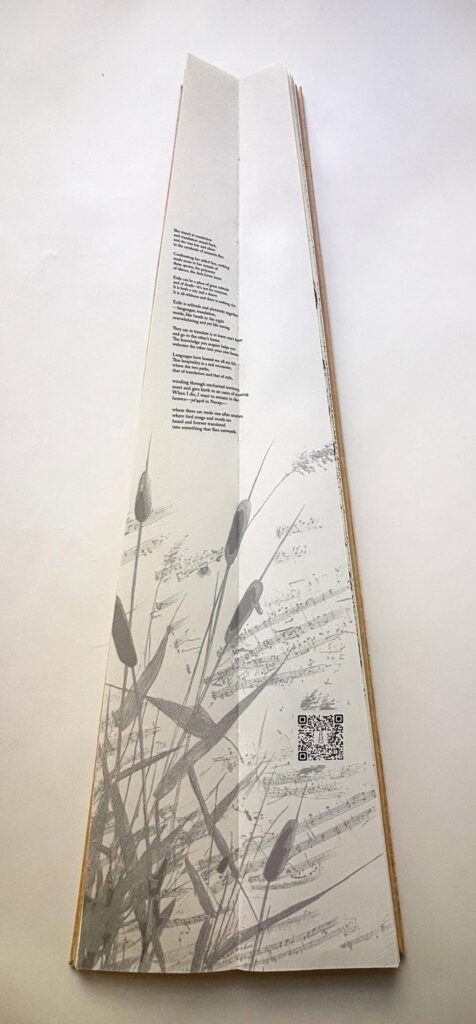
YÁ’ĄĄSH
What is your mother tongue?
The kind of question that makes me
stumble and stop dead in my tracks,
like a confused steed. Pain response.
Can you mount a wild mustang?
Words? Languages? Comets? All my life
I’ve ridden them—and a horse
only once, in Death Valley
—two days of hot sand
in the mouth, longing for
a drink like a fresh expression
in another language—Navajo.
One day I will learn the hardest
language in the world
because of that white shell horse
I rode across the desert.
That which is wild will run away from you.
That which claims to make sense will never stop
fleeing—childhood, names, language—
like when I was eighteen and amnesiac,
bewildered. Radiant yet benumbed,
lost for words and expecting
meaning in a burning hot desert,
seeking a path to the unconscious.
A Navajo man set me on the back
of the kind mare Kiowa.
I didn’t know what her name meant.
I didn’t know where we were heading.
The Navajo language is described by translator
William Morgan who wrote the first Navajo-English
dictionary as a hopeless maze of irregularities
—33 consonants and 12 vowels to convey thoughts,
and what you hear and what you smell,
what you see and what you feel.
Kiowa is said to come from the Comanche
Kaigwa: “two halves differ,”
like a word and its translation.
Each time you translate a word
you divide or fragment
its meaning, you only translate
or extract part of its body.
The word you have translated differs
from the word you have used to translate it:
it’s missing a strand of hair, sometimes an ear,
like the modern equid
it has a single toe instead of fifteen.
But it must stand on strong legs—
a broken leg means a death
sentence for a horse, a dead
sentence in a translation, a broken reed—
and both words stare at each other
in the translation mirror.
A tree is a tree, a horse is a horse,
but is a bel étalon a beautiful stallion?
And how wild is an étalon sauvage?
How much rage and courage
in one and the other?
They differ, yet, together
they complete one another.
In another language
you may not recognize yourself at all.
You see a multitude,
this untamed herd of you,
the floating milk-white manes,
the shapes and musculatures
riding connotations and denotations,
not riding home, writing home—
without knowing who’s alive or dead.
A language can make you
more alive than another, the reality
shaped by the words that come out of
your mouth can laugh or yawn,
your whole face can become more visible,
hair curlier or straighter, like the nose,
skin darker or lighter, like the wings—
if the poem is poorly
translated, the centaur flies in circles
in the confines of an invisible cage.
High, low, rising, falling—words
of tonal languages have different meanings
depending on the way they are pronounced.
In Navajo, changing the pitch of a word
can alter its meaning, just like in Vietnamese
(ma can mean horse, ghost, tomb or mother),
my má’s native language,
which is not my mother tongue.
I don’t have one—the Yiddish mame
-loshn and the Hebrew sfat-em sound warmer
than the mother—her razor—tongue
tearing to shreds the emotional
connection. I lost, on the path
of exile, a home, a language,
a mother, and the wounds too.
In the need to be hosted by others
in order to survive, one realizes that
languages are as good a home
as four walls and a roof. Translating
poetry is like living in exile
—Nothing perhaps is more anti-
identity than poetry and the translation
of poetry, said the translator Claude Mouchard—
it’s looking at something that makes you weep
and grieve until it turns into a fruitful field
that becomes an endless forest
so dense, so ramified
it’s always dark inside.
Is meaning a forest of trees
and branches above the ground?
An entanglement of roots
beneath the earth?
In Italo Calvino’s words and world
meaning is a maze of tree roots in forest—
a hopeless maze of irregularities, like Navajo?
The forest is as wild as it is fertile.
Instead of a mother tongue I have a secret
name in my mother’s mother tongue:
Anh-Thu, “female hero; refined and courageous.”
Anh-Thu juxtaposes anh, the Sino-Vietnamese
word for “flower, petal” to thu
the Sino-Vietnamese word for “autumn.”
Exile also means having different names,
a Sino-Vietnamese one, and another one
in a language different from your parents’
—Sabine, of Latin origin.
The Sabines or Sabini were an ancient Italian tribe
who lived in the central Apennine mountains
and were known for their resilience in battle.
Sabine and Anh-Thu go hand in hand
with their hybrid manes
that scream exile,
defy and expand meaning,
defy translation.
That which is hybrid
is untranslatable.
Names are like any word,
at heart they are untranslatable.
The untranslatable transforms translators.
The untranslatable makes translators
bloom at night like moonflowers
in lines of poetry.
The untranslatable makes the translators’
horizon boundless, it’s the eat-me cake
that turns translators
into telescopes and giants,
the drink-me potion that shrinks them down
so they can scurry around the poem,
roam its strange and wide rooms,
in order to try to interpret their content.
Translating is like being exiled
on a sea of ever-changing words.
Translating is like a Mad Tea Party
where time changes shape then freezes still.
Vietnamese is the language my mother is
the most proficient in and the one
she spoke with her own mother.
French and English are the languages I am
the most proficient in,
I spoke them only with strangers.
I have spent many more years
living in a Hebrew-speaking country
than in a French- or an English-speaking one.
How do we become who we are…
Thanks to—or against—poetry?
Guillaume Métayer asks in A comme Babel.
I used to have a friend from Birmingham
who felt lonely in the French language,
the same way I felt lonely in my childhood—
She stuck strips of paper all over
her Paris flat with Bible verses in English,
including the bathroom,
including the mirror.
Words of wisdom and comfort
articulating and aggravating
her solitude, which stared back at her
when she looked at her own reflection,
at her beauty, fears, distortions,
at past and possible
versions of herself.
Every day she stumbled upon
the stranger in herself.
She stared at translation
and translation stared back,
and she was lost and silent
in the cavalcade of semantic flux.
Confronting her exiled face, nothing
made sense to her outside of
these quotes, the polysemy
of silence, the dark forest maze.
Exile can be a place of great solitude
and of death—it’s not for everyone.
It is both a city and a desert.
It is all wildness and there is nothing else.
Exile is solitude and plenitude together
—languages, translation,
words, like hands in the night
overwhelming and yet life-saving.
They say to translate is to leave one’s home
and go to the other’s home.
The knowledge you acquire helps you
welcome the other into your own home.
Languages have hosted me all my life.
This hospitality is a real encounter,
where the two paths,
that of translation and that of exile,
winding through uncharted territory,
meet and give birth to an oasis of meaning.
When I die, I want to remain in this
heaven—yá’ąąsh in Navajo—
where there are reeds one after another,
where bird songs and words are
heard and forever translated
into something that flies outwards.
Sabine Huynh. February 28th, 2025.
To listen to YÁ’AASH by Sabine Huynh from the Making Sense series by artist Servane Briand, click here.